


 Martin Reeves
 Mihnea Moldoveanu
 Adam Job
 Greg Emerson
 Matthew Kropp
 Julie Bedard
 Lisa Krayer
 Viacheslav Romanov
 Megan Hsu
 Luis Sanchez Boedo
 Diya Mohnot
Over the next two to three years, 50% to 55% of jobs in the US will be reshaped by AI. For many employees, this will mean that they retain the same or a similar role but face radically new expectations for how they work and what they produce. For company leaders, it will require a clear vision for how the transformation is managed, including a scaled, strategic approach to upskilling and reskilling and the restructuring of career ladders.
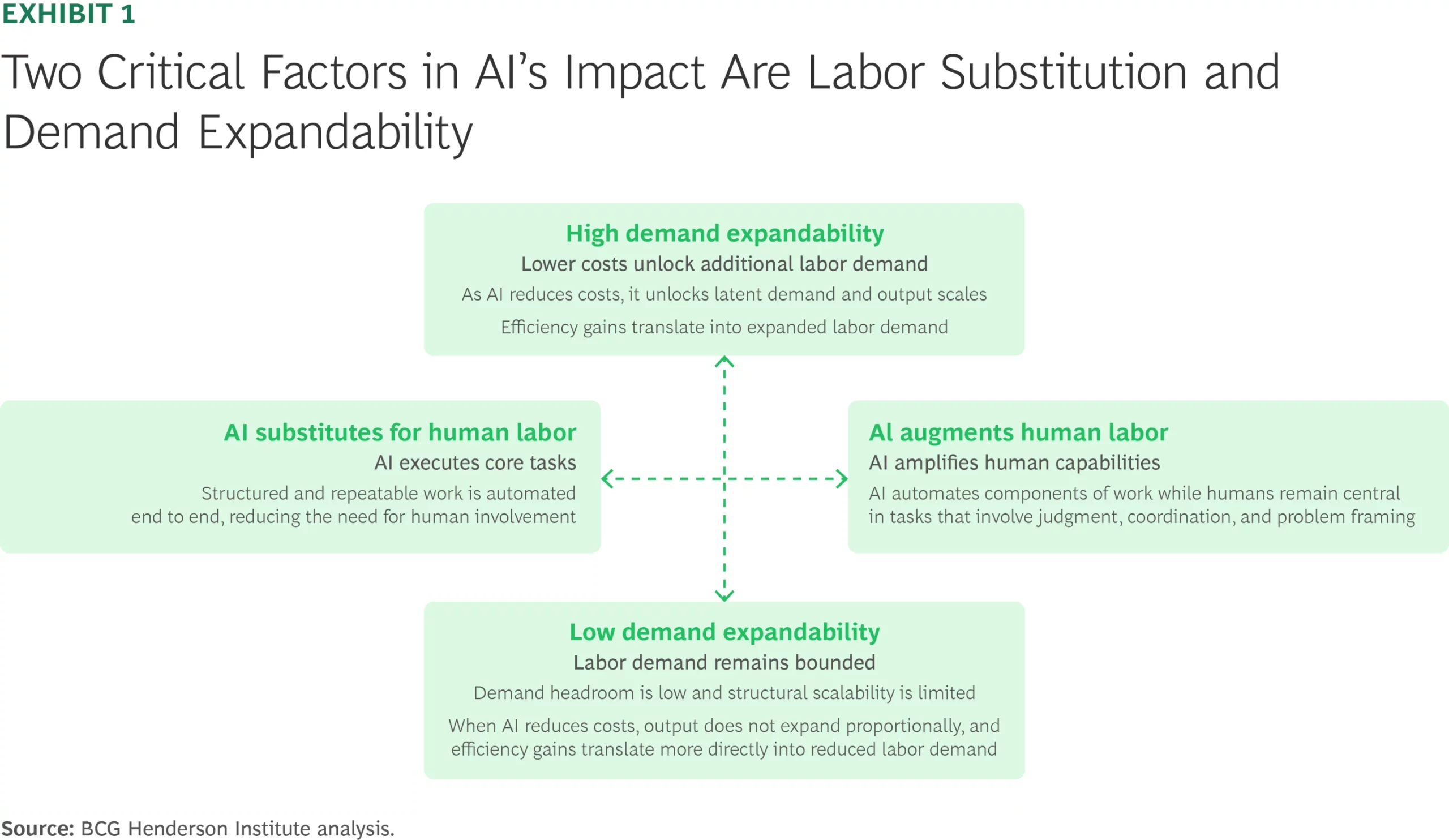
This shift is already happening—and will pick up speed as AI adoption spreads. Our analysis, based on microeconomic modeling, identified a significant swath of the labor force for which AI will meaningfully augment current roles. Moreover, when the productivity gains from AI use trigger increased end product demand and the potential for augmentation is high, we believe there will be a need for more and, in some cases, new human roles. (See Exhibit 1.) While job augmentation and new-job creation will happen rapidly, full substitution of jobs by AI will be slower. Five years from now—or perhaps further in the future—10% to 15% of jobs in the US could be eliminated.[1]This number assumes 165 million US jobs filling 1,500 roles. This level of potential job loss is considerable and creates an important call to action for business leaders.
Critically, our analysis is not intended to be an unemployment forecast. It does not account for macroeconomic factors such as geopolitics or inflation, nor does it contemplate the impact of new AI breakthroughs beyond the capabilities of today’s frontier models. Moreover, our model can’t solve for powerful and influential unknowns, such as the future impact of AI on the accessibility of jobs and the speed with which the technology is adopted.
