

 Martin Reeves
 Mihnea Moldoveanu
 Adam Job
 Nikolaus Lang
 Sylvain Duranton
 Vladimir Lukic
 Matt Langione
 Rodrigo Ortiz Mena
 Jona Lampert
 David Zuluaga Martínez
The AI landscape today is dominated by the US and China, as both countries continue to put the weight of their private and public sectors behind the development of this technology.[1]Generative AI has been the focal point of the commercial and geopolitical competition since 2024, but agentic and physical AI are rising in relevance—hence this piece’s broader use of “AI” … Continue reading But despite the superpowers’ shared recognition of the importance of AI as a source of national power, their AI strategies have diverged. Each country is developing an AI technology stack designed to reduce its dependence on the other—which also means their stacks are increasingly incompatible. CEOs and policymakers across the globe may have to choose sides sooner than they think.
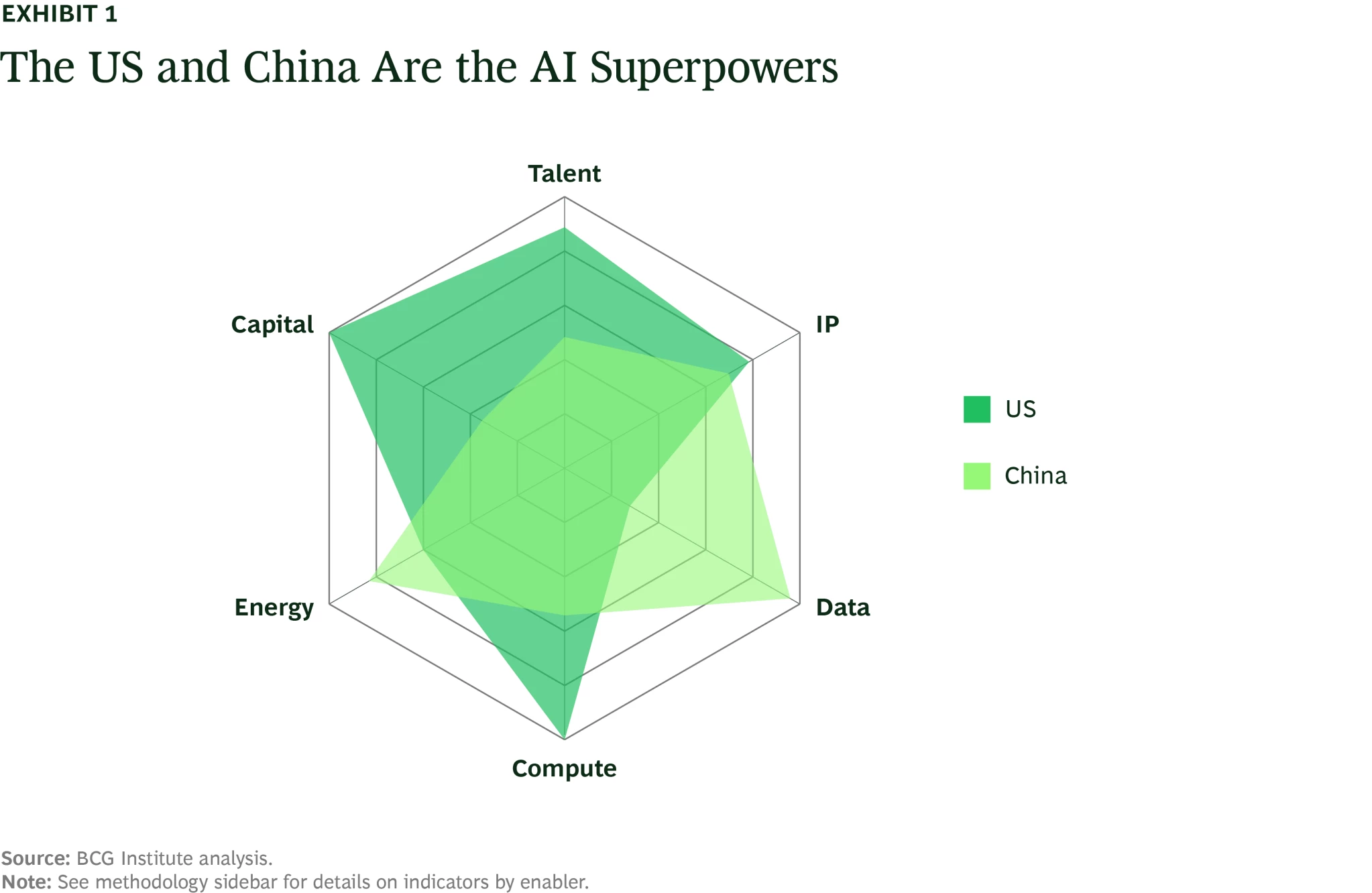
In 2024, we argued that the US was the clear leader in the burgeoning AI race, with China quickly gaining ground. Our updated, 2026 analysis across the six key enablers of AI supply—capital, talent, intellectual property (IP), data, energy, and compute—reveals the US has maintained its lead, fueled by its strength in talent and capital deployment. But China has continued to close the gap on compute power and has systematically translated its IP strengths into a consistent “fast follower” approach to frontier model development, with clear focus on rapid adoption of AI across the real economy. (See Exhibit 1.)